
Agrivoltaics in Maryland: Balancing Farmland Conservation and Clean Energy Goals
Written by Siddhi Pawar, National Center for Smart Growth (NCSG)
Introduction
When sustainability and conservation goals compete for the same resources, how do we determine what gets prioritized? Maryland’s commitment to renewable energy expansion and farmland preservation is surfacing this tension, as both goals are vying for the same land. A new study from the University of Maryland Environmental Finance Center (EFC) and the National Center for Smart Growth (NCSG), in partnership with the Harry R. Hughes Center for Agro-Ecology, aims to address this conflict, asking how agrivoltaics, or the co-location of solar energy and agricultural production, may offer a viable strategy for resolving these overlapping priorities. The study evaluates how existing incentives and policy influence implementation, how much land is available, and how stakeholders perceive the practice.
Background & Tension
Maryland has set ambitious goals in the pursuit of its sustainability agenda. The Climate Solutions Now Act (2022) is aiming to cut greenhouse gas emissions 60% below 2006 levels by 2031, achieve 100% clean electricity by 2035, and reach net-zero emissions by 2045. A provision of this net-zero emission goal is that at least 14.5% of retail electricity sales should come from solar by 2028. This means that roughly 9,500 acres of mostly flat, open land close to grid connections is needed to reach the state’s solar energy targets. Concurrently, the Maryland the Beautiful Act (2023) aspires to conserve at least 40% of the state’s land by 2040, requiring the protection of an additional 600,000 acres, with agricultural lands being the most prioritized for preservation and conservation.
While these policy goals progress to meet their targets, they are often established in their respective sectors, creating friction when they ultimately compete for the same land, funding, political relevance, or infrastructure. Ground-mounted solar favors flat, open, unshaded sites, which is characteristic of productive farmland. Maryland has been adding around 250 megawatts (MW) of solar every year, but meeting its renewable energy standards will take nearly double this rate. Additionally, rapid growth in data center development is placing greater pressure on both energy demand and land.
Mixed perceptions around solar also play a role in the relationship between solar and farmland. For some agricultural landowners, solar leases on land offer stability for income, while for others it implies degradative impacts on soil conditions and the loss of productive land. Without a framework to address these overlaps, decisions tend to fall on a per-project, county by county, or parcel by parcel level, leaving interconnected goals fragmented.
Agrivoltaics, then, appears as an attractive option that may alleviate some of these points of conflict, as it promises solar development while continuing agricultural practices. The practice is versatile such that it could include grazing under solar panels, the growth of crops between or under panels, or even the placement of solar infrastructure on agricultural buildings. The benefits, however, remain speculatory in Maryland, given the state’s diverse landscape and microclimates, as existing agrivoltaics research is sparse in the context of the Mid-Atlantic region.
Study Design
The study uses three connected approaches: a policy review, land use analysis, and stakeholder interviews.
Policy Review: Maryland’s major climate, energy, land conservation, solar siting laws, and county policies were examined. Agrivoltaics policies in other states were also evaluated to determine alignment, gaps, and conflict.
Land Use Analysis: A statewide geospatial analysis was conducted to approximate the acreage of agricultural lands that could be compatible with agrivoltaic practices. Data on crops, parcels, terrain, protected lands, and proximity to three-phase electrical distribution and transmission lines was sourced from the USDA Cropland Data Layer and statewide inventories. Steep slopes and wetlands were excluded from the analysis. Land was sorted into six categories: commodity crops, grazing, hay, non-crop, specialty crops, and perennial crops. Roof space on agricultural structures, such as poultry sheds and large barns, was also estimated. Spatial analysis was done using a hexagonal grid, with each cell measuring 0.125 square kilometers in area. Results were reported on an aggregated county level, across a statewide grid, to protect landowner privacy.
Stakeholder Interviews: 90-minute virtual discussions were held with five groups: state agencies, local governments, farmers and agricultural advocates, solar developers and renewable energy advocates, and nonprofit and academic researchers. The project team remained as a neutral party and did not advocate for any particular outcome.
Key Findings
Overarching Takeaway: There is a sufficient amount of agrivoltaic-compatible land in Maryland to meet the state’s current energy targets, but there is a need for a more coordinated and integrated state-level framework to ensure that agrivoltaic projects are properly sited, regulated, and monitored.
Policy Analysis:
Maryland state and local policies, regulations, and exemptions are paving the way to better incentivize and encourage agrivoltaic systems as one remedy for land use conflict. The Renewable Energy Certainty Act of 2025 (RECA) exempts qualifying agrivoltaics systems from property tax, offers relaxations on siting regulations that would normally be applied to solar facilities, and caps commercial solar at 5% of a county’s Priority Preservation Areas (PPA), which are a county’s protected farmland and forests. Concerns expressed from farmers about site work damaging land productivity are addressed through additional soil protections, such as minimum grading on solar sites and prohibitions on topsoil removal. Additionally, a 2026 legislative regulation (HB 734/SB 344) extended timelines for community solar projects on farmland to qualify for tax benefits from 2025 to 2030. Projects can submit an agrivoltaics plan that allows the state authorities to inspect and revoke these benefits if agricultural activity stops.
Limitations, however, exist. For example, RECA excludes apiaries, or bee yards, and pollinator habitats from its definition of agrivoltaics. This is particularly important because many farmers and advocates view pollinator management as a feasible gateway into agrivoltaic practices.
Additionally, the ambiguity surrounding agrivoltaic policy in the state persists, as stakeholders have collectively expressed hesitancies surrounding the qualifications of certain solar and farmland practices, such as confusion about utility-scale solar adjacent to active farmland or the level of integration between systems. Other states offer ideas and best practices through demonstration projects, solar support on working lands, and enforceable standards, all of which Maryland can consider when moving forward with agrivoltaic regulations.
Land Use Analysis:
There is more than 1.3 million acres of agricultural land in Maryland with suitable terrain for agrivoltaic systems, such that it is possible for agricultural practices and land protections to co-exist. As mentioned, at approximately 5 acres per MW, the state needs 9,500 acres of land to meet its solar goals. More than 540,000 acres of the available agricultural land is unprotected and within the proximity of distribution or transmission lines. Furthermore, more than 150,000 acres of the topographically favorable agricultural land is unprotected and has access to both distribution and transmission lines (Figure 1). Even if agrivoltaic practices need more land per MW to accommodate different site designs, there would still be sufficient acreage throughout the state to meet energy targets. For example, if systems required 20 acres per MW, projects would occupy roughly 25% of suitable farmland in the most grid-adjacent areas.
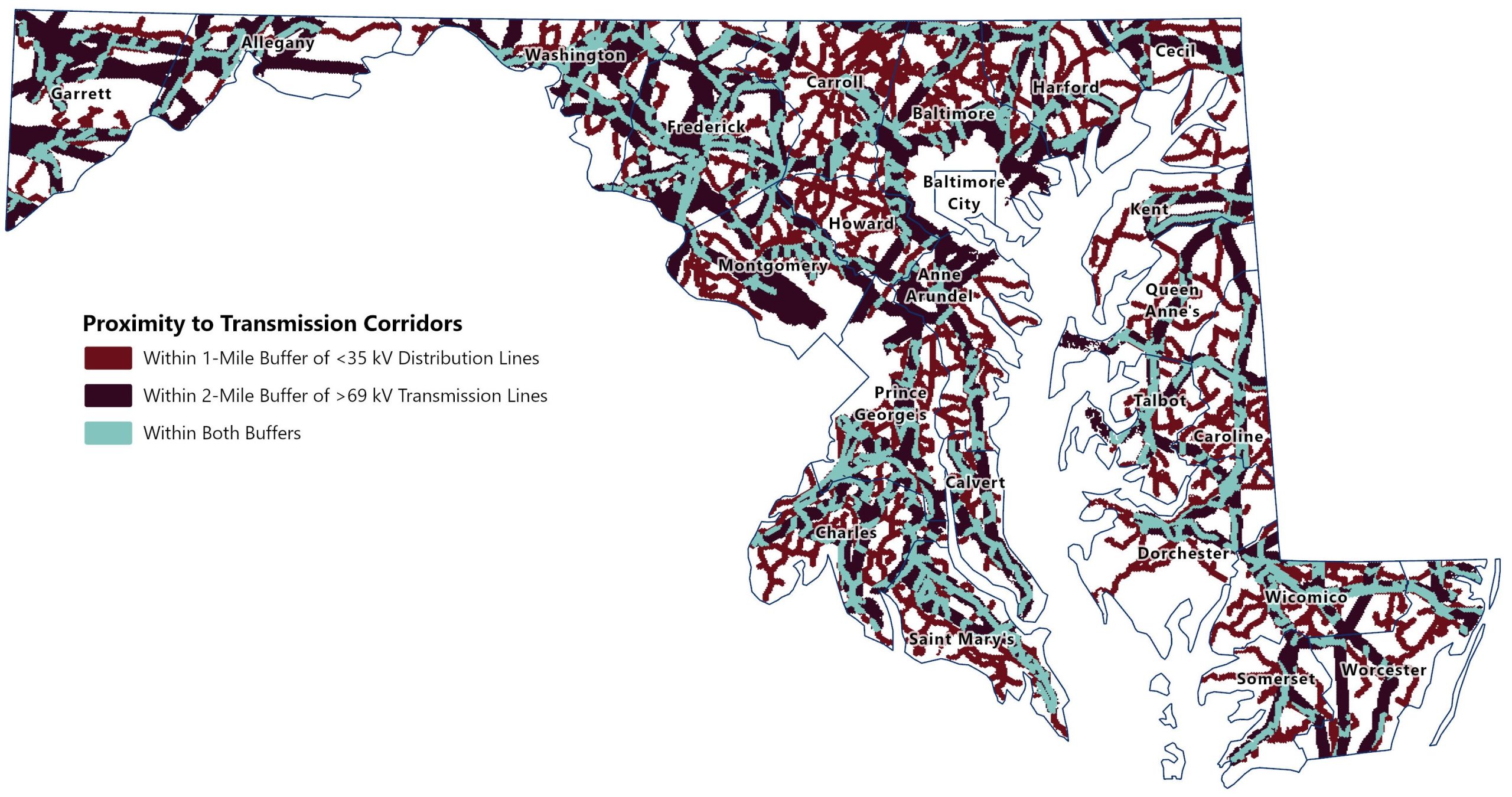
Figure 1. Proximity to electric distribution and transmission lines from the Maryland Department of Natural Resources SmartDG+ tool, which include lines that “appear strong enough to absorb large-scale [>2 MW] projects.” Includes 1 mile buffers around distribution lines <35 kW, 2 mile buffers around transmission lines >69 kW, and areas within both buffers.
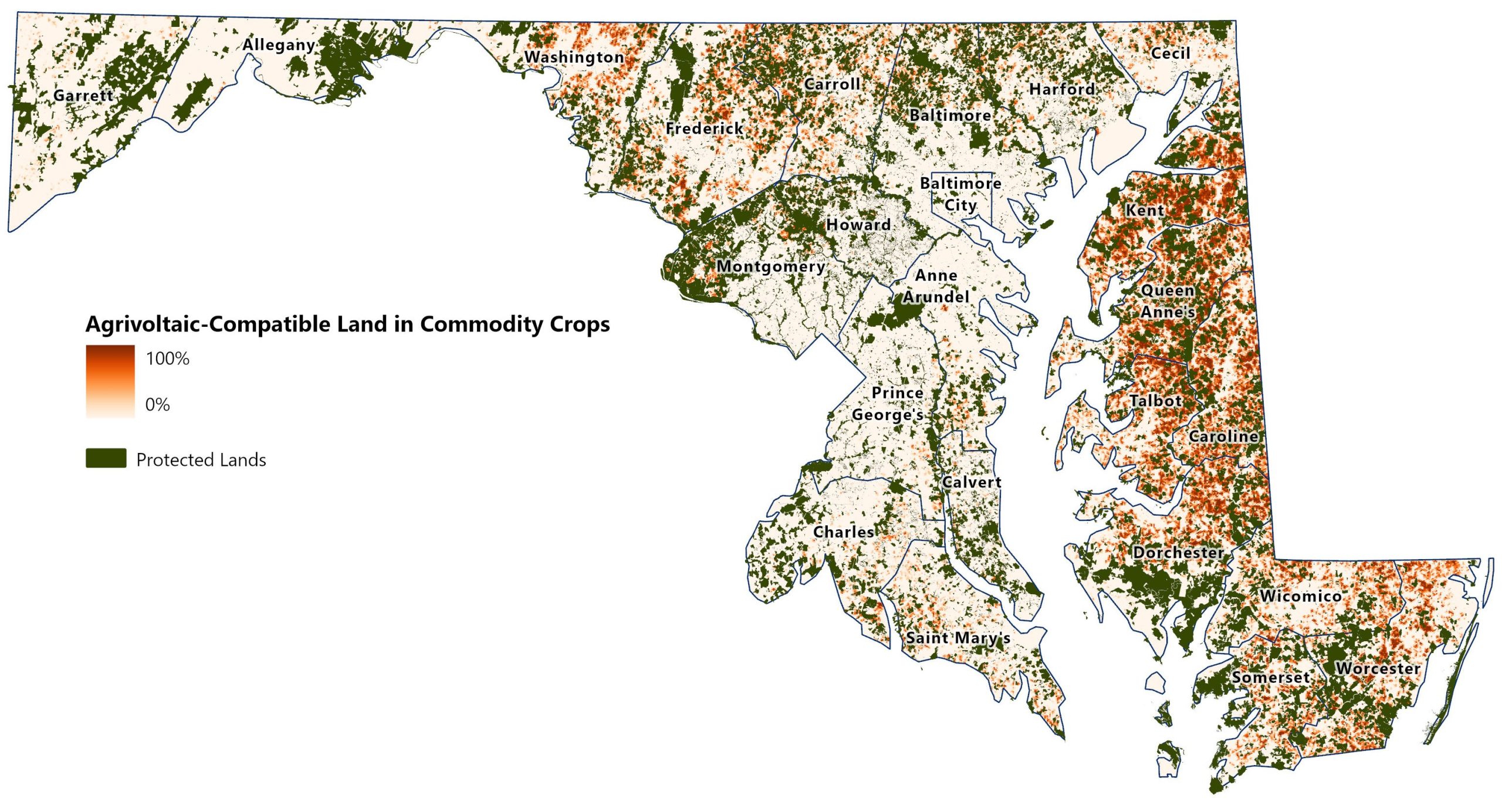
Figure 2. Distribution of agrivoltaic-compatible land in commodity crops across Maryland, overlaid with protected lands. Land use percentages are calculated across a hexagonal grid with cells each 0.125 square kilometers in size. Cells with 100% of land in commodity crops are shaded most deeply. Cells with no land in commodity crops are shaded most lightly.
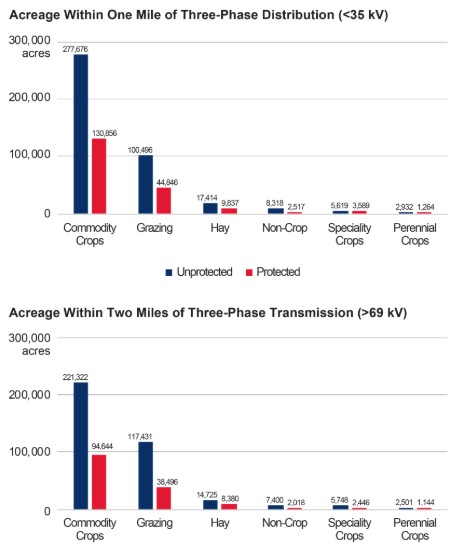
Figure 3. Acreage of agricultural lands by use category within one mile of three-phase distribution corridors (<35 kV) and two miles of three-phase distribution corridors (>69 kV). Excludes land on steep terrain and wetlands that would be unsuitable for photovoltaics.
Grazing follows as the second most productive, with greater concentrations in Western Maryland counties (Figure 4). While specialty and perennial crops, hay, and non-crop land hold potential for more intensive agrivoltaic co-location, these lands currently do not cover adequate acreage across the state to satisfy energy goals.
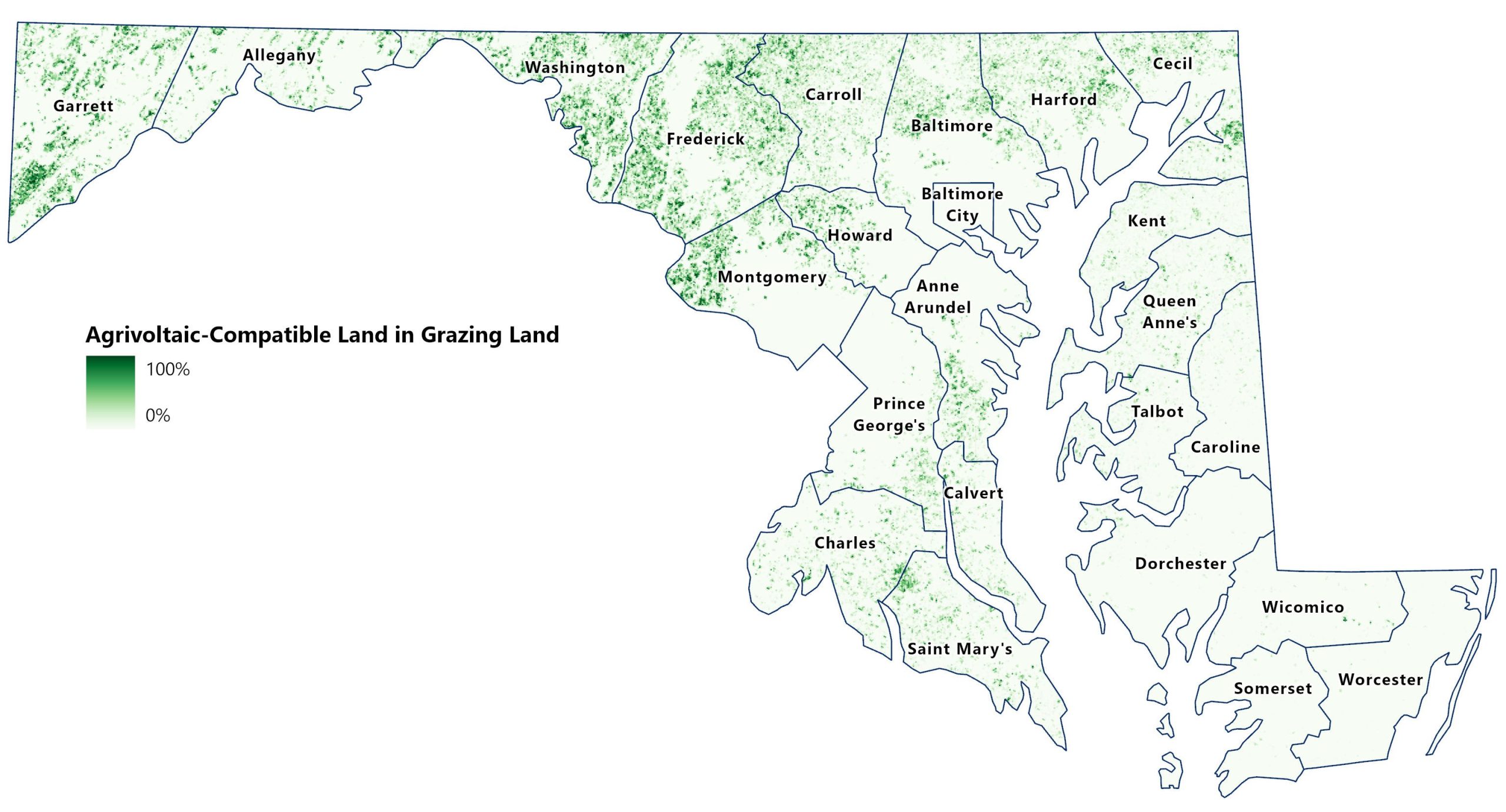
Figure 4. Distribution of agrivoltaic-compatible land used for grazing across Maryland. Land use percentages are calculated across a hexagonal grid with cells each 0.125 square kilometers in size. Cells with 100% of land used for grazing are shaded most darkly. Cells with no land used for grazing are shaded most lightly.
Finally, large agricultural buildings offer some opportunities for solar development. 22%, or 2,100 acres, of the needed 9,500 acre target could be fulfilled by retrofitting building rooftops with photovoltaic capacity. While the acreage may not measure up to cropland potential, it provides a different option, utilizing existing infrastructure connections and mitigating impacts to farm and protected lands. Most large agricultural building footprints are poultry sheds concentrated in the Eastern Shore. Practical and financial limitations may apply, however, as existing roof structures likely do not have the structural integrity to support solar arrays.
Stakeholders:
Across the interviewed groups, participants showed support for exploring agrivoltaic practices as potential mechanisms to address expanding solar capacity and agricultural preservation, but a lack of clarity surrounding regulation makes the future path of this strategy uncertain. Stakeholders named four primary needs: strengthen Maryland-specific agrivoltaic evidence, establish a shared understanding of appropriate siting, provide unbiased information and education for landowners and farmers to make informed decisions with developers, and develop a state-level framework to address the land use tensions.
Moving Forward
This report finds that while the physical capacity to support agrivoltaics in the state of Maryland exists, barriers largely reside in a shortage of strategy and policy for implementation. If agrivoltaics is to be a trusted practice, Maryland should look to:
- More clearly define terms so that projects that claim agrivoltaic benefits are genuinely integrating solar and farming.
- Establish accountability such that there is ample verification of the continuation of agricultural activity on farmland with solar facilities and that sites are decommissioned properly.
- Develop a trusted, evidence-based Maryland practice so that farmers and landowners can better weigh the context-specific legal, financial, agricultural implications of systems and lease agreements.
Maryland already has the institutions to coordinate energy and agricultural goals, but what is missing are clear policies, resources, mandates, and political direction that will steer the state to achieve its objectives.
Read the full report for more information, or explore the accompanying research briefs, which provide major takeaways for a variety of stakeholders.