
2025 Maryland Commuter Survey

The Maryland Commuter Survey (MCS) is an ongoing project conducted by the Transportation Policy Research Group at the University of Maryland in partnership with the Maryland Department of Transportation (MDOT). It provides an annual snapshot of commuting patterns, as well as longitudinal trends as the survey is conducted year-over-year. The 2025 MCS, the survey’s fourth iteration in its current form, shows how workers across the state have adjusted their work and commuting patterns as the state continues to emerge from the pandemic. This and future versions of the survey will track how workers commute amidst developing economic opportunities and challenges, and preferences about where they live and work. While the MCS focuses on commuting, it also captures other aspects of how workers live, work, and travel, shedding light on how commuting patterns relate to Marylanders’ broader lives.
Key Findings from 2025
Commute times, distances, and transportation modes have remained largely stable since 2022.
- The MCS measured an average one-way commute time of 29 minutes in 2025, the same as in 2022 and 2024. The 2023 survey measured an average of 31 minutes, but this difference was within the survey’s margin of error.
- The average distance between home and work was 12 miles in 2025, the same as in 2023 and 2024. This was a marginal increase from 11 miles in 2022.
- The most common way workers commuted in 2025 was by automobile, including drive alone, carpool, and ride-share, which accounted for 71% of commute trips. Telecommuting displaced 16% of commutes that might otherwise have been made by a physical mode of transportation. The portions of commutes made by automobile, transit, walking and bicycling, and telecommuting remained at similar levels between 2023 and 2025.
Remote work has stabilized at a level higher than before the pandemic.
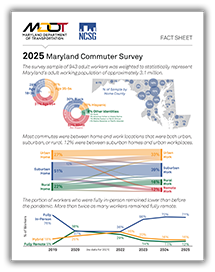
- In 2025, 29% of workers reported either hybrid or fully remote work arrangements; 71% worked fully in-person.
- The share of workers who were fully in-person increased dramatically between 2022 (36%) and 2023 (66%), then stabilized from 2024 (72%) to 2025 (71%). The difference between 2024 and 2025 was within the survey’s margin of error.
- Fully remote workers made up 5% of the workforce before the pandemic, peaked at 38% in 2020, then stabilized within the margin of error between 2023 (14%), 2024 (11%), and 2025 (12%).
- The share of workers with hybrid schedules was stable between 2024 (16%) and 2025 (16%), similar to the level before the pandemic (18%).
Many Maryland workers did not follow a traditional daily commute pattern.
- Only 52% of workers reported commuting to and working from a consistent location each work day.
- The remaining workers followed non-traditional work patterns, including:
- 16% were hybrid workers who sometimes telecommuted,
- 12% were fully remote workers who always telecommuted,
- 6% were self-employed from home, with no potential commute,
- 13% commuted to job sites that changed regularly, drove for work, or traveled for work directly from home.
- Approximately one-third of physical commute trips began during off-peak hours, including 15% of trips that began overnight (9:00 pm–5:59 am) and 10% that began mid-day (10:00 am–1:59 pm).
- The share of afternoon commutes increased from 27% in 2023 to 31% in 2025, but the overall daily pattern of strong morning and afternoon peaks remained consistent since 2023.
Transportation insecurity affected a substantial portion of workers and was strongly patterned by primary commute mode and demographics.
- Based on indicators from the Transportation Security Index, 35% of workers faced transportation insecurity.
- 40% of workers identifying as people of color were transportation insecure compared with 30% of white workers, and 45% of workers with a disability were insecure compared with 33% of those without disabilities.
- Workers who primarily relied on transit (59%) or carpooling (49%) were substantially more likely to be transportation insecure than those who drove alone (31%) or teleworked exclusively (29%).
Overall satisfaction with Maryland’s transportation system remained high.
- In 2025, 83% of workers reported being somewhat or very satisfied with transportation services provided by MDOT, including 51% somewhat satisfied and 32% very satisfied.
- 17% of workers reported being somewhat or very unsatisfied (13% somewhat unsatisfied and 4% very unsatisfied).
- 62% of workers agreed that “public transit can take me where I want to go,” while 20% disagreed and 18% were neutral.
- Satisfaction increased modestly over time, rising from 78% in 2023 to 84% in 2025.
Documents
| Publication | Date |
| 2025 Maryland Commuter Survey Fact Sheet | February 2026 |
| 2025 Maryland Commuter Survey Final Report | February 2026 |
| 2024 Maryland Commuter Survey Fact Sheet | April 2025 |
| 2024 Maryland Commuter Survey Final Report | April 2025 |
| 2023 Maryland Commuter Survey Fact Sheet | April 2024 |
| 2023 Maryland Commuter Survey Final Report | April 2024 |
| 2022 Maryland Commuter Survey Fact Sheet | March 2023 |
| 2022 Maryland Commuter Survey Final Report | March 2023 |