
Factory-Built Housing in Maryland
Written by Rebecca Garman, Doctoral Student and National Center for Smart Growth Graduate Assistant
Introduction
Manufactured and modular housing – also called “factory-built housing” – offer a promising strategy to address the housing affordability crisis. Industrialized production offers time savings, favorable economies of scale, and gains in quality and energy efficiency, and the resultant cost efficiencies can translate to greater affordability for residents [1, 2, 3]. Given Maryland’s significant housing shortfall to accommodate projected growth, accelerating the production and development of factory-built housing can help address this gap.
However, these benefits can be offset by regulatory barriers and entrenched attitudes that deter the manufacture, construction, and placement of factory-built housing in communities. The State of Maryland passed the Housing Expansion and Affordability Act (HB 538) in 2024, which prohibits county and city governments from denying the placement and construction of a new manufactured home or modular dwelling in single family residential zones. [5] The Act presents an opportunity to produce more housing units by streamlining localized land use controls around the placement of factory-built housing, which currently cause delays and confusion in the development process.
However, there are lingering issues that present challenges to unlocking greater uses of factory housing in Maryland. Utilizing public data and qualitative interviews with representatives from industry groups, manufacturers, and developers, this study explores how barriers emerge throughout the lifecycle of factory-built housing – from manufacturing and design, through transportation, development, and permitting – that can make it challenging to produce these housing units at scale. Given that one of the most significant obstacles in producing more factory-built housing in Maryland is local land use and zoning, the report also includes policy audit analysis of the county ordinances and zoning codes in seven counties in the state. The paper concludes with a discussion of notable practices and lessons learned from other states.
Regulatory Landscape for Factory-Built Housing
While both manufactured and modular homes may be produced in-part or fully in a factory setting and transported to a site for installation, they are defined and regulated by different levels of government. The National Manufactured Housing Construction and Safety Standards Act of 1974 defined manufactured housing and provided a nationwide building code for these homes, whereas modular homes are defined and regulated by the State of Maryland and are subject to state and local building codes. [1] There is no national modular building code, and an estimated 38 states, including Maryland, have state-specific modular building standards and programs. [6, 7]
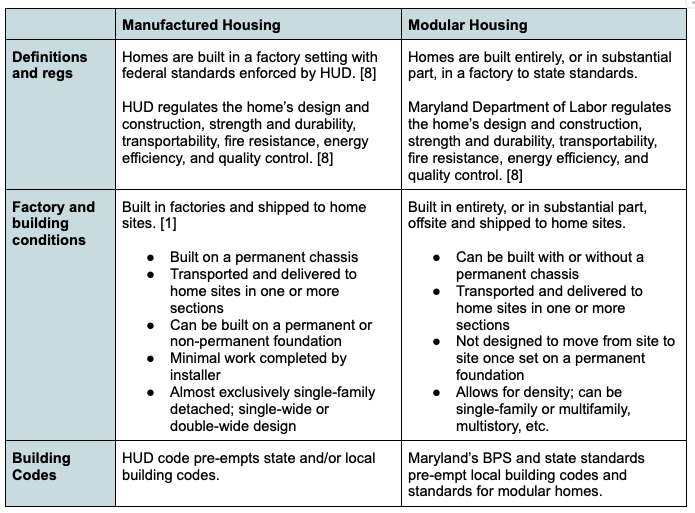
Figure 1: Distinctions between manufactured and modular housing.
Manufacturing and Developing Factory-Built Homes in Maryland
Maryland is served by a regional network of factory-built manufacturers. Maryland does not have any manufacturing plants, but nearby Pennsylvania and Virginia have 12 and 1 plants, respectively, as of mid-2024. [8] There is a limited supply of modular manufacturing facilities in that provide full-service modular home construction in Maryland. Nearby states have a variety of modular housing facilities, as well as prefabricated parts producers and/or trade-related services. This clustering can partly be attributed to lower land costs in nearby states, as well as real and perceived market demand.
!["It becomes a chicken and egg situation. It's tough to have a commitment of units if you don't have a facility [in place], and it's tough to get financing in place for a facility and be credible if you don't have a pipeline of unit commitments." (Industry interviewee, 2025)](https://www.umdsmartgrowth.org/wp-content/uploads/2026/04/Quote.png)
Transportation and shipping are important dimensions of this regionalized manufacturing ecosystem. More localized transport results in downstream savings for the developer, which factors into the final sale price. Sufficient demand is also essential to meet the required economies of scale to ensure the manufacturing facility is appropriately staffed and productive. However, Maryland has seen little uptake of factory-built housing, compared to other states. Over the last ten years, manufactured housing shipments have remained relatively static. Maryland has tended to have some of the lowest numbers of shipments within the region, except for the District of Columbia.

Figure 2: Annual Shipments of Manufactured Housing Units to Maryland and Nearby States, 2014-2024. Credit: NCSG analysis of the US Census Bureau’s Annual Manufactured Housing Survey.
Given these dynamics, as well as the long-term opportunities to increase jobs and material outputs, Maryland should foster an ecosystem of producers and servicers of industrialized construction. In the meantime, Maryland can and should take a regional perspective by planning for greater production opportunities; encouraging a greater local uptake of factory-built housing; and collaborating with the growing network of organizations, academic institutions, and industry partners in supporting the incubation of industrialized construction facilities, services, and jobs.
The development of factory-built housing in Maryland is driven by market dynamics and influenced by state and local policy frameworks. From a market perspective, high land costs create major barriers to developing more factory-built housing at scale. Further, in many jurisdictions, zoning regulations may outright ban manufactured housing, whether in manufactured housing communities or on privately owned lots, which adds complications and expenses to projects to rezone or seek exceptions or variances. [2] Counties across the state have wildly different definitions and approaches for modular housing. Some have defined rules around modular homes, whereas others don’t address it.
These inconsistencies also highlight a clear need for capacity building and ongoing training and support for Maryland counties around factory-built housing. There is a tremendous opportunity for the state of Maryland to support local governments in updating their codes to be in alignment with HEAA. State leadership will be key in supporting counties’ move from planning and policy to implementation and build capacity and knowledge to ease barriers.
References
- Dawkins, C. J. (2025). Local land use regulations and new mobile home concentration. Urban Studies. https://doi.org/10.1177/00420980251335564
- Kaul, K. & Pang, D. (2022). The Role of Manufactured Housing in Increasing the Supply of Affordable Housing. The Urban Institute Accessed at https://www.urban.org/research/publication/role-manufactured-housing-increasing-supply-affordable-housing
- Rumbach, A., Sullivan, E., Curran-Groome, W., Rosenow, A., & Cohen O. (2025). Building a Climate-Resilient Manufactured Housing Stock. The Urban Institute. Accessed at https://www.urban.org/research/publication/building-climate-resilient-manufactured-housing-stock
- Maryland Department of Housing and Community Development. (2025). Turning the Key: Unlocking Maryland’s Potential. Accessed at https://dhcd.maryland.gov/TurningTheKey/Documents/HB538-FAQ.pdf Maryland
- National Center for Smart Growth. (2025). 2025 State Housing Need Assessment Released. Accessed at https://www.umdsmartgrowth.org/news/2025-shna/
- Modular Building Institute. (n.d.). Breaking Down the “Modular Building Code.” Accessed at https://www.modular.org/2020/02/03/breaking-down-the-modular-building-code/
- ICC NTA. (2025). Ten Things to Know About Building with Modular/Off-Site Products. Accessed at https://www.icc-nta.org/ten-things-to-know-about-building-with-modular-off-site-products/#:~:text=State%20modular%20programs%20exist%20in,to%20construction%20of%20any%20type.
- Maryland Department of Labor. (n.d.). Manufactured (Mobile) Homes and Modular Homes- Building Code Administration. Accessed at https://labor.maryland.gov/labor/build/buildmobilehud.shtml
- Manufactured Housing Institute. (2024). Manufactured Home Plant List. Accessed at https://www.manufacturedhousing.org/wp-content/uploads/2024/09/Plant-List-7_3_24.pdf