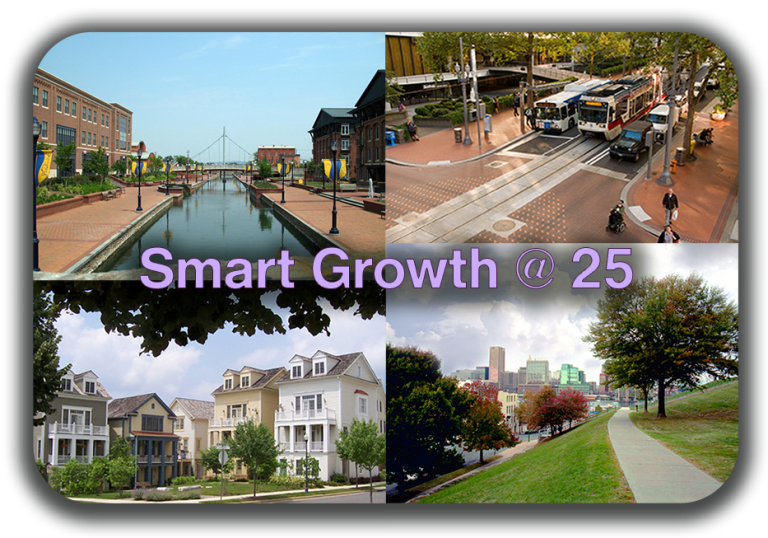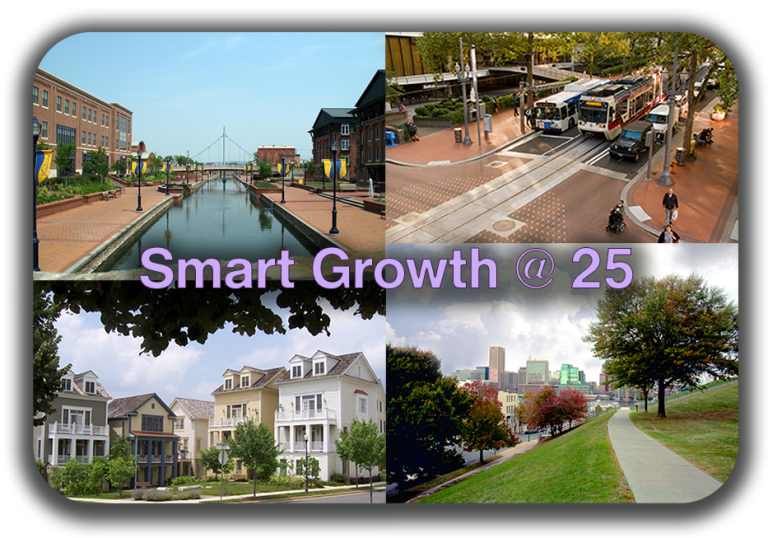
Smart Growth @25 Webinar Series
Professor and Director Gerrit Knaap and multiple NCSG alums will jointly host a series of webinars for the Smart Growth Network, sponsored by the Maryland Department of Planning and the US EPA Office of Sustainable Communities. Please find more details here and RSVP here. The first session is Tuesday July 13th at 1:00 p.m. EDT — see below.
The seeds of smart growth were planted in 1991 with the articulation of the Ahwahnee principles at a conference in central California. Over time, these evolved into 10 principles that have now become widely known. These Smart Growth Principles propose a development pattern that is compact, with mixed uses and sense of place, a range of transportation and housing options, dotted with public open spaces and surrounded by farms, forests, and natural resources. The benefits of such development patterns were purported to include less driving and improved physical health, more affordable housing in high quality neighborhoods, and cleaner air, water, and global atmosphere and more.
It has now been 30 years since the seeds of smart growth were first planted and 25 years since the APA published The Growing Smart Legislative Guidebook and Governor Glendening signed the Maryland Smart Growth Act. The years since have produced countless workshops, conferences, interactive websites, professional reports, and academic research. Yet it is difficult to find a source that answers basic questions such as:
- How have the concepts of smart growth evolved over time?
- What has the academic research revealed in terms of the validity of smart growth concepts?
- To what extent have the principles of smart growth become embedded in the plans, regulations, and policies of state, local, and federal government agencies?
- Have we made significant progress addressing the problems that the smart growth movement was created to address?
- What new challenges have arisen that the original smart growth principles failed to address?
Toward that end, Professors Gerrit Knaap (University of Maryland), Rebecca Lewis (University of Oregon), and Arnab Chakraborty (University of Illinois at Urbana-Champaign) commissioned leading scholars to write papers that address these questions. Those papers will soon be published by Edward Elgar in a forthcoming Handbook on Smart Growth.In advance of the publication of that book the Smart Growth Network will present four webinar sessions that address the history, principles, and implementation of smart growth, what we have learned about the original principles of smart growth, new salient issues that were not addressed by the original principles, and where smart growth needs to go from here.
Session 1
Session #1: Looking Forward, Looking Back
Tuesday, July 13 at 1:00 p.m. EDT
The book editors will introduce the webinar series and the challenges advocates for smart growth face today. They will review the history of the smart growth concept and provide an overview of its evolution over time. They will address governance issues and describe how smart growth has been pursued at the local, state, regional, and national levels.
The panel includes Gerrit Knaap of the University of Maryland, Rebecca Lewis of the University of Oregon, Arnab Chakraborty of the University of Illinois, and John Landis of the University of Pennsylvania.