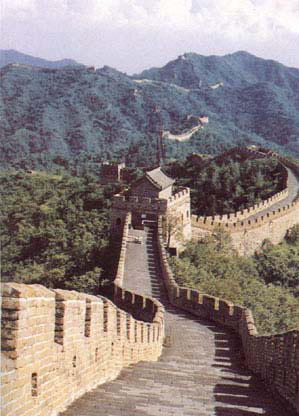
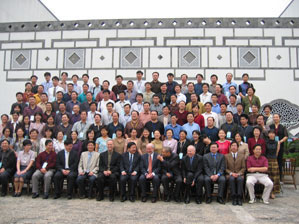
Wuyi Demonstration Project on Integrated Planning, July 2007, Zhejiang Province, China
China's institutional system, which plays an important role in shaping urban form and contributing to sustainable urban
development, is divided into several key government agencies/authorities such as the National Development and Reform Commission (NDRC),
the Ministry of Construction (MOC), the Ministry of Land and Resources (MLR), and government units responsible for different transportation
system (rails, roads, air-industry, metro-transits). Each has its own plans, administrative structure, approval and implementation
schemes. Even though laws have mandated harmony and coordination among plans administered by these agencies, conflicts prevail,
making it difficult for local government officials to implement or act according to plans.
The Wuyi demonstration project, essentially a technical assistance effort, aims to develop a protocol system in which land use plans,
urban plans, transportation plans, and socioeconomic plans are integrated to better shape the urban landscape. This demonstration
is sponsored by the Lincoln Institute of Land Policy and supported by the Wuyi local government. The Demo Project is led by Chengri
Ding (P.I.) from University of Maryland, Cifang Wu (Co. P.I.) from Zhejiang University, Yan Song from University of North Carolina
at Chapel Hill, Yang Zhang from University of Illinois at Springfield, Gerrit Knaap from University of Maryland, Terry Moore of
ECONorthwest Ltd., Weiwen Zhang of Zhejiang University. The Zhejiang Provincial Commission on Development and Reform also supports
the Demo Project.
Past Demonstration Projects
Urban Comprehensive Plan.
This is a 2004 collaborative project with the Beijing Urban Planning Committee and Ministry of Construction.
Beijing is preparing for a new revision of its comprehensive plan, and
one of the biggest challenges that Beijing urban planners face was how to develop a comprehensive plan that will work in a
transitional economy that is moving toward a free-market system. The Lincoln Institute's China Land Program provided training
as well as technical assistance in the development of master/comprehensive plan(s).
Farmland Preservation in the Era of Fast Urbanization.
Through collaboration with the Ministry of Land and Resources, two regions experimented with a new farmland preservation instrument:
The use of a zero net-loss of farmland productivity policy in place of the current practice of a zero net-loss of farmland policy.
Training, research, an international workshop, and exchanges have taken place from 2004 through 2005.
Property Taxation Development and Fiscal Decentralization.
In collaboration with the Development Research Center (DRC) of the State Council, this project involving the development
of a property taxation program for china was conducted from 2004 through 2005.