|
China Land Policy Program - Land Issues In China |
 |
Urban Planning
Urban development in China is often carried out in a setting in which planning controls are few or seldom implemented.
It is a demanding and challenging task to build urban planning capacity not only because of the character of the urban problems, but also due to the scarcity of qualified urban planners, the lack of tools in place for the planner to administer, and the absence of training in the skills and procedures appropriate to the culture and conditions.
As John M. Courtney of the World Bank Institute points out in his book, Strategy for Urban Planning Capacity Strengthening—East Asia, there are many challenges facing the practice of urban planning in China:
Past Weakness: City planning is viewed as an exercise to achieve the “city beautiful?ideal.
Master plans are relied on to lay out a perfect end-state for the city.
Yet, there has been little concern over the practical integration of services through budgeting; land markets and management; or the cost and affordability of the expected end-state.
Little attention has been paid to issues of economic efficiency or social equity.
Instead, the importance of the process of planning was usually neglected in favor of planning only by one or a few government departments, with stakeholders often limited to influential developers who could obtain inside information on land and development opportunities.
Central and city governments and aid agencies rarely took these planning exercises seriously, and they were relegated to show pieces for visitors while the actual city development occurred as if they did not exist.
Actual implementation was mainly for infrastructure projects, planned by engineers on a sector basis, not coordinated with other services.
The underlying problem is a misunderstanding of the function and role of urban planning.
The essence of urban planning is to identify the results needed from the development process and the needs of the various stakeholders, then with their participation, to produce a strategic vision and practical, affordable action plans for implementation.
This involves trade-offs and options which can be examined through a transparent, decision-making process.
As urban areas become more complex and interests of the stakeholders more diverse and forcefully expressed, this planning process becomes increasingly important.
This involves a strong element of ‘public interest?which can be said to be the ethical basis of planning.
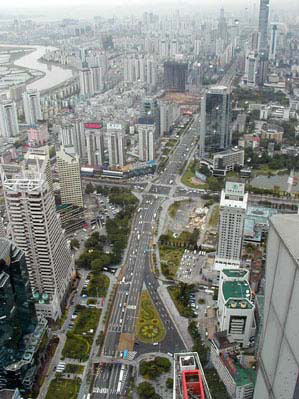
Development Forces Demand Better Planning: The speed of urbanization and the growing size of cities in China demand better planning.
The key task to urban planners is to find ways to enable Chinese cities to manage fast urbanization efficiently while avoiding human or environmental damage.
This can be done, in part, by realizing each city’s distinctive potential; addressing issues of social inequality; addressing issues of environmental degradation; developing a stronger sense of priorities and improving coordination and linkages between institutions.
Planners in China face a series of new and emerging challenges:
- The world-wide movement towards decentralization and democratic decision-making;
- Proliferation of civil society interest groups, whose concerns need to be incorporated into planning;
- Globalization;
- The countervailing demand for local control over the urban economy;
- Citizens?rising concerns over environmental and cultural matters; and,
- New challenges in public health and safety.
Focus on Knowledge and Practice: Both regional urban development strategies as well as intra-urban planning for metropolitan and secondary cities need to be strengthened to deal with the speed and scope of urbanization in China
Comprehensive and Strategic Planning: Emphasis is needed to develop visions and alternative urban development scenarios for consideration of decision-makers, on the definition of priorities and the analysis and distribution of benefits of alternative courses of action.
Environmental Planning: Analysis is needed of how natural resources support urban areas, the causes and effects of pollution and degradation, prioritizing and working with polluters, and integration of natural resource management plans with the overall urban policies and planning.
Advocacy Planning: Special focus is needed on working with disadvantaged groups to help increase their power and influence in the decision-making process.
Efforts must be made to increase knowledge of the social and economic dynamics of low-income populations, to assist communities in preparing their local plans and negotiating with government agencies.
Action Planning: The planning approaches mentioned above need concrete methods to make them effective.
These may include:
- Demographic, economic, asset and employment analysis;
- Spatial analysis;
- Infrastructure networks planning;
- Land markets and management;
- Demand management, economic and regulatory instrument;
- Costs, their affordability and distribution;
- Central-local institutional and financial relations, local revenue generation and fiscal and financial management;
- Inter-sector planning, coordination and budgeting; and,
- Information and monitoring systems and dissemination.